A living sacred site and relic-filled stupas in one loop. This half-day tour in Anuradhapura is built for clear, story-driven Buddhism and history explanations at places like Jaya Sri Maha Bodhi and Ruwanwelisaya. I love how the schedule fits a 3 to 4 hour window without feeling rushed, and I love that it’s led by a Sri Lanka licensed guide who focuses on monuments and how they connect to the wider story of Buddhism. One catch to plan for: monument admission fees and other taxes are not included, so you may need extra cash or card on the day.
You’ll start at 8:30 am near the Jaya Sri Maha Bodhi area, and the tour ends back at the same meeting point. Pickup is offered, and you also get snacks and water plus a mobile ticket to help things move smoothly. It’s private, so it’s easier to ask questions and get the meaning of what you’re seeing without competing for attention.
In This Review
- Key points that make this half-day Anuradhapura loop work
- Entering Anuradhapura at 8:30: how the timing shapes the experience
- Jaya Sri Maha Bodhi: the sacred Bo tree you treat like a time machine
- Lovamahapaya Brazen Palace: ruins that explain a whole architectural idea
- Ruwanwelisaya: seeing a Mahathupa as a relic-focused stupa
- Jetavanarama and Abhayagiriya ruins: when the scale starts to register
- Thuparama, Samadhi Buddha, and the Mahamewna Park cluster
- Isurumuniya Temple: Devanampiya Tissa’s legacy in a focused visit
- Kuttam Pokuna Twin Baths: why preserved ponds are worth your attention
- Wessagiriya and the moonstone: finishing with details you’ll remember
- Price and value: what $30 per person really buys you
- Who should book this half-day sacred Anuradhapura circuit
- Should you book this tour or plan it on your own?
- FAQ
- How long is the half-day tour?
- Where is the meeting point?
- Where does the tour end?
- Is pickup included?
- What is included in the tour price?
- Are admission tickets included for the monuments?
- Is an air-conditioned vehicle included?
- Is this a private tour?
- What if I need to cancel, or the weather is poor?
Key points that make this half-day Anuradhapura loop work
- Licensed, explanation-first guiding that connects monuments to Buddhism and Sri Lankan history
- A tight 3–4 hour route that hits major sites in a practical order
- Pickup + private group so you’re not navigating alone across the sacred core
- Snacks and water included, useful for a morning-focused outing
- Mobile ticket convenience, while key monument fees are still separate
- Built around Mahamewna Park / Mahamevnāwa Park highlights, so you see clusters efficiently
Entering Anuradhapura at 8:30: how the timing shapes the experience
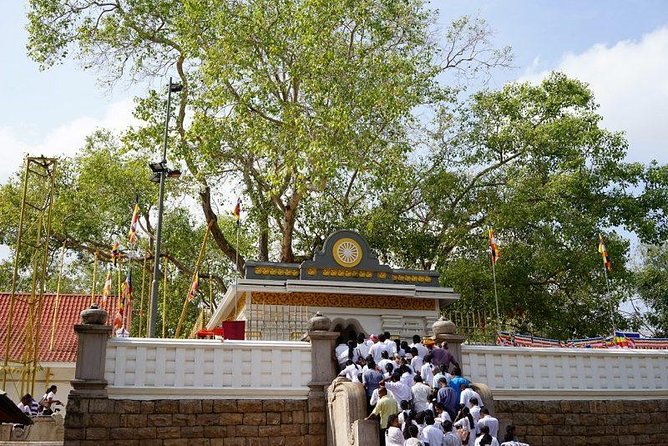
Starting at 8:30 am is a smart choice for this kind of sacred-city walk. In a short half day, you want your energy and attention when the monuments are still easy to take in, not when you’re thinking about lunch and shade.
This tour is also designed for a “real looking” pace. You’re stopping at a sequence of major landmarks—sacred trees, brazen-roofed palace ruins, big stupas, monastery remains, and carved architectural details—without making you feel like you’re sprinting between photo spots.
The private setup matters more than you’d think. When it’s only your group, your guide can slow down for questions and clarify what you’re seeing, instead of sticking to a rigid lecture timeline. And since the guide is a licensed professional focused on Buddhism and monuments, the explanations tend to land faster and stick better.
You can also read our reviews of more tours and experiences in Anuradhapura.


Jaya Sri Maha Bodhi: the sacred Bo tree you treat like a time machine
Your first major stop is Jaya Sri Maha Bodhi in the Mahamewna Gardens. This is a sacred Bo tree (Ficus religiosa), and it’s described as the closest authentic living link to Gautama Buddha. That one sentence changes how you view the site—this isn’t just a monument, it’s framed as a living connection.
Give yourself time here, because it’s the kind of place where context matters. A guide can help you understand why a tree becomes a central focus of devotion and historical continuity, instead of just being another landmark in a list.
Admission is not included for this stop, so treat the tree visit as part of a bigger budgeting plan. I suggest planning to carry a little extra for entry fees, since the tour is priced as a guided experience rather than an all-in museum ticket.
Lovamahapaya Brazen Palace: ruins that explain a whole architectural idea
Next comes Lovamahapaya, also known as the Brazen Palace or Lohaprasadaya. It sits between Ruwanweliseya and Sri Mahabodiya in the ancient city of Anuradhapura. The name Brazen Palace points to the roof, which is the key feature behind that nickname.
Even in ruins, this kind of building works best when you know what to look for. With a guided explanation, you can focus on how the structure’s purpose and design fit into the broader sacred zone rather than treating it as a random pile of stones.
The quick stop length (about 15 minutes) is enough if you’re not expecting a deep archaeological dig. Use this as a “mental orientation” pause: you’re learning the city layout and architectural language before moving into the bigger stupa monuments.
Ruwanwelisaya: seeing a Mahathupa as a relic-focused stupa
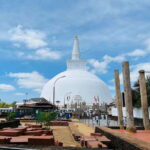
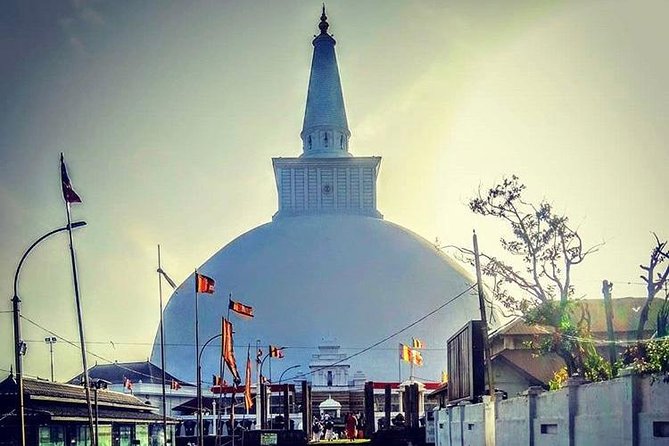
Then you’re at Ruwanwelisaya, also called the Ruwanweli Maha Seya or the Mahathupa. This is a stupa, a hemispherical reliquary structure containing relics. The main idea here is that the shape and design are part of the spiritual function, not just a visual style.
When you stand near a stupa like this, the guide’s explanation helps you connect the physical form to its role as a reliquary. You stop being a passive observer and start reading the monument like a symbol.
As with other key sites, admission tickets are not included. Still, the value of the stop is that you’re guided through what a “stupa as container of relics” means, and why this makes Ruwanwelisaya one of the central points in Anuradhapura.
Jetavanarama and Abhayagiriya ruins: when the scale starts to register
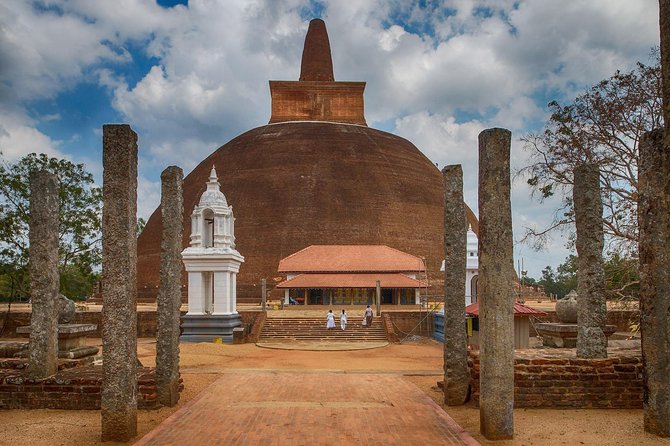
The tour continues to Abayagiriya Stupa, also connected to Jetavanarama or Jetavanaramaya. This stupa is located in the ruins of Jetavana monastery, and it’s tied to the UNESCO World Heritage context. Even if you only have a half day, UNESCO-level sites come with a feeling of size and importance, and your guide can help you make sense of that scale.
From there, you visit Abhayagiri Dagaba, tied to the Abhayagiri Vihāra monastery complex. This is described as a major monastery site linked to Mahayana, Theravada, and Vajrayana Buddhism. It’s also noted as one of the most extensive ruins in the world.
That mix of Buddhist traditions is a powerful takeaway. It tells you Anuradhapura wasn’t locked into a single religious expression; it functioned as a big crossroads of belief and practice across different strands of Buddhism. When a licensed guide explains how those traditions relate to the site, the ruins stop looking like broken walls and start looking like evidence of real historical movement.




Thuparama, Samadhi Buddha, and the Mahamewna Park cluster
A strong part of this route is the way it uses the Mahamewna Gardens / Mahamevnāwa Park area. You visit Dagoba of Thuparama (Thuparamaya), described as the first Buddhist temple constructed after the arrival of Mahinda thero in Sri Lanka (Mahindagamanaya). It’s located in the sacred area of Mahamewna park, which helps you feel the “cluster effect”—multiple key meanings close together.
From there, you go to the Samadhi Statue, a famous Buddha statue in Mahamevnāwa Park. The Buddha is depicted in the Dhyana Mudra posture associated with meditation. Even without extra time, this stop is valuable because it shifts you from monument scale to personal practice imagery.
In a short tour, the balance matters. Stupas and monastery ruins can feel huge and distant, while a single statue pose gives you something intimate to picture. Your guide’s explanations help you connect that small detail (Dhyana Mudra) to the bigger themes of how Buddhism is practiced, not only built.
Isurumuniya Temple: Devanampiya Tissa’s legacy in a focused visit
Next is Isurumuniya Temple, identified with the ancient Meghagiri Vihara or Meygiri Vihara. It’s presently identified as Isurumuni Vihara, and it was built by King Devanampiya Tissa (307 BC to 267 BC), the ruler associated with the ancient capital of Anuradhapura.
That time frame makes this stop feel different. You’re not only looking at a site; you’re looking at a specific reign tied to a specific building history. In a half day, a guide who can connect a date range to the physical place helps you absorb it instead of forgetting it right after you leave the grounds.
Admission tickets are not included, so again, plan for separate entry fees. But the payoff is that you get a named historical anchor, which is the kind of detail that makes sacred-city sightseeing feel real.
Kuttam Pokuna Twin Baths: why preserved ponds are worth your attention
Then it’s Twin Baths (Kuttam Pokuna)—two well-preserved old bathing tanks or ponds in ancient Anuradhapura. These ponds were built by the Sinhalese in the ancient Anuradhapura Kingdom and are part of the city’s heritage layout.
In many sacred-city tours, water features get treated like filler. Here, they deserve attention because they reveal the everyday infrastructure around religious life. Even with limited time, you can treat this as a “how people lived beside the sacred” stop, not just a pretty ruin.
A guide can help you understand what made these ponds important in the overall urban design. This is also one of the stops where your eyes do the work—stone edges, water channels, and preservation quality all help you form a quick mental picture.
Wessagiriya and the moonstone: finishing with details you’ll remember
The last leg includes Wessagiriya, also known as Issarasamanarama. It’s described as an ancient Buddhist forest monastery and part of the ruins of Anuradhapura. The location detail that it sits about half a mile south of Isurumuniya helps you picture how the sacred network sprawls beyond the main “big monuments.”
After that, you reach Moonstone (Sandakada pahana), a unique Sinhalese architectural feature. The moonstone is an elaborately carved semi-circular stone slab placed at the bottom of sacred architecture elements, according to the description. Even if you only spend about 20 minutes on this, it’s a great final stop because it brings you back to artistry and design language.
Carved details can feel random when you’re tired. But if you get a quick explanation about what the moonstone represents and how Sinhalese architecture uses this feature, you’ll leave with a specific thing to remember besides “big stupa, big ruins.”
Price and value: what $30 per person really buys you
At $30.00 per person, this tour is priced as a guided experience with practical support. Snacks and water are included, and the guide-led explanations are the core value—especially since your route mixes sacred sites, monumental ruins, and architectural elements that can be confusing without context.
Admissions and fees are not included, so the true day cost will depend on what entrance charges you encounter at each stop. That isn’t a bad deal—it just means you should budget a little extra and avoid surprises when you reach ticket points.
Also note that an air-conditioned vehicle is not listed as included. Pickup is offered, but if you’re sensitive to heat or sun during short transfers between sites, plan accordingly with light clothing and water. The tour itself is short enough to manage, but Sri Lanka’s pace can still feel warm when you’re moving through outdoor grounds.
Who should book this half-day sacred Anuradhapura circuit
This is a good fit if you want a guided, meaning-focused route without losing half the day. It also works well when you don’t want to piece together a monument plan yourself.
You’ll especially enjoy it if:
- You like Buddhism and history explanations and want a licensed professional to connect the dots
- You’re short on time in Anuradhapura and want the highlights in a single morning block
- You prefer a private group experience so you can ask questions on the spot
- You enjoy details like carving features (like the moonstone) as much as major stupas
If you’re the type who wants hours at one monument with minimal moving around, you might feel the pacing is quick. But for most visitors, the 3 to 4 hour structure is exactly what makes it doable.
Should you book this tour or plan it on your own?
I’d book it if you’re aiming to understand Anuradhapura instead of just checking boxes. A licensed guide who explains Buddhism and Sri Lankan monuments can turn stones and stupas into a clearer story, and the private setup keeps the experience flexible.
If you’re comfortable navigating alone and you’re happy reading monument info without a guide-led narrative, you could DIY some of these stops. But given how many sites touch different aspects of Buddhism, architecture, and ancient kingdom life, the guided version is the more efficient way to learn in a half day.
My practical advice: bring money for admission tickets since fees aren’t included, and plan for a morning outing that’s mostly outdoors. Do that, and this route gives you a strong concentration of sacred Anuradhapura without the “I spent the day travelling” feeling.
FAQ
How long is the half-day tour?
It runs for about 3 to 4 hours.
Where is the meeting point?
The tour starts at Jaya Sri Maha Bodhi (89VW+VV5, Anuradhapura, Sri Lanka).
Where does the tour end?
It ends back at the meeting point.
Is pickup included?
Pickup is offered.
What is included in the tour price?
Snacks and water are included, and you’ll receive a mobile ticket.
Are admission tickets included for the monuments?
No. Admission tickets and all fees and taxes are not included.
Is an air-conditioned vehicle included?
Air-conditioned vehicle is not included.
Is this a private tour?
Yes. It’s private, and only your group participates.
What if I need to cancel, or the weather is poor?
You can cancel for free up to 24 hours in advance for a full refund. The experience requires good weather; if it’s canceled due to poor weather, you’ll be offered a different date or a full refund.