Surfing lessons in Sri Lanka are a lot of fun. What you want is calm coaching and real progression. Ama Surf School Weligama is built for that exact moment when surfing feels stuck and you’re ready to learn the basics that actually transfer to open waves.
I like the small-group approach (up to 5 students) because it keeps the instruction practical instead of generic. I also like that the lesson starts in waist-deep water, so you’re not forced into the deep end before your body learns the moves.
The main thing to think about is the weather requirement. Surf sessions depend on good conditions, so you’ll want to be flexible with your schedule in case the surf gets canceled and you’re offered a different date or a full refund.
In This Review
- Key things that make this beginner surf lesson work
- Ama Surf School Weligama: what you’ll actually learn
- Your 6:30 am start: meeting point and how the session runs
- Land basics first: safety, stance, and jump-up technique
- Waist-deep group surfing: what that means for first-timers
- Soft boards then fibreglass: how progression is handled
- Paddling out and catching waves: the skill behind standing up
- Turning and balance: what to focus on during your coaching time
- Price and value: why $70 can make sense for beginners
- Who this is best for (and who should look elsewhere)
- Practical tips so you get the most from your morning session
- Should you book this beginner surf lesson in Weligama?
- FAQ
- How long is the group surf lesson for beginners?
- Where do I meet for the lesson?
- What time does the session start?
- Do I need to know how to swim?
- What boards do beginners use?
- Can I cancel if the weather is bad?
Key things that make this beginner surf lesson work
- 5 students per instructor keeps feedback frequent and useful
- Waist-deep practice helps first-timers feel safe and focused
- Soft boards first, fibreglass later supports real skill growth
- Core safety + jump-up technique teaches you how to start surfing, not just how to fall
- Rotating coaching in the water means you get one-on-one attention throughout
- A clear beginner skill checklist covers paddling, stance, turning, and catching unbroken waves
Ama Surf School Weligama: what you’ll actually learn
This beginner session is designed for people who feel stuck—maybe you’ve tried standing up on a wave and then everything falls apart. The goal here is not magic. It’s basics, drilled until they become automatic.
You’ll focus on the core surfing skills that matter most early on:
surf safety, how to jump up, footwork and stance, core balance, and how to turn the board. Then comes the paddle game: efficient paddling out, technique, and finally catching and riding unbroken waves.
What’s especially smart is the order. You’re not thrown straight into chaotic wave chasing. The school starts with the basics you’ll need to survive the ocean part, then builds toward the fun part—trimming and turning with the wave face instead of just tumbling over it.
You can also read our reviews of more tours and experiences in Galle.



Your 6:30 am start: meeting point and how the session runs
You meet at Ama Surf School Weligama by the Weligama By Pass Road (81700). The start time is 6:30 am, and the activity ends back at the meeting point.
A morning start matters for beginners. Surf conditions are often calmer earlier, and you’re more likely to get good water time before the sea turns choppier or busier. Also, showing up early tends to reduce the stress factor. You get time to settle in, talk to the instructor, and get your head right before you hit the water.
The session is listed at about 1 hour 30 minutes. In real life, the school’s pacing tends to be practical: short land teaching, then quick movement into the water. One review even notes the time can run a bit longer than expected, which is a nice bonus if you’re having fun and learning fast.
Land basics first: safety, stance, and jump-up technique
Even if you’re brand new to surfing, you’ll get structure on land before you paddle out. This is where you learn how to move your body so your first attempts don’t feel like pure luck.
Expect instruction around:
- Surf safety (how to behave around waves and board control basics)
- Jump-up technique (the move from lying down to standing without panicking)
- Footwork and stance (where your feet go so you can balance instead of wobble)
- Core balance techniques (simple body control so the board doesn’t feel like it’s floating away from you)
This land phase is not just “theory.” It helps you avoid the most common beginner problem: standing up with the wrong timing. When your body learns the sequence on land, the ocean becomes the practice space instead of the puzzle.
Waist-deep group surfing: what that means for first-timers
The lesson takes place in waist-deep water. That’s a big deal. It means you’re learning in a controlled setting where you can stand up quickly, regain control, and focus on technique instead of survival.
You do not need to know how to swim to participate. That doesn’t mean you should ignore safety—just that the environment is chosen to support beginners. For many people, this is the difference between freezing with fear and actually enjoying the lesson.
The group format is also key. It’s built around one instructor for up to 5 students, and the school shares time by rotating around. Translation: you’re not stuck watching someone else while you wait your turn. You’ll get tips throughout, not just at the start.
Soft boards then fibreglass: how progression is handled
The teaching plan uses the right equipment for the stage you’re in. Beginners start on soft surf boards, then later move onto fibreglass boards.
Why that progression matters:
- Soft boards reduce the shock of learning. They help you stay calmer when you lose balance, and they’re easier to manage while your stance and footwork are still developing.
- Fibreglass boards feel more “real,” and once you’ve got basic control, switching teaches you to handle a firmer, more responsive board.
In a lot of surf schools, people bounce straight from nothing to something advanced. Here, the equipment change supports learning, so you’re not stuck forever on a board that only works when you’re still scared.





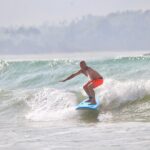
Paddling out and catching waves: the skill behind standing up
Anyone can flail on a board. The trick is paddling efficiently so you can be in the right place when the wave shows up.
You’ll get guidance on:
- Paddling technique
- Efficient paddling out
- How to catch and ride unbroken waves
For beginners, the “unbroken wave” piece is important. It’s teaching you to aim for cleaner riding, not chaotic surfing where you’re forced to react every second. When you’re learning, cleaner waves are how you build confidence and timing.
A good beginner lesson should make the wave feel predictable. Not easy—just less random.
Turning and balance: what to focus on during your coaching time
Once you can pop up and stay upright briefly, the next step is control. This lesson includes turning the board and core balance work, which is where many first-timers realize surfing isn’t just standing—it’s steering your body and board together.
During your time in the water, the instructor rotates and gives coaching in real time. That’s where you can ask for quick corrections and actually test them immediately:
- Is your stance stable when the wave pushes?
- Do you rotate your body to turn, or do you just drift?
- Can you keep your balance long enough to ride the face instead of falling off early?
If you’ve ever tried surfing and thought, I can stand, but I can’t go anywhere, this is the part that usually unlocks progress.
Price and value: why $70 can make sense for beginners
At $70 per person for about 1.5 hours, the price can feel either fair or steep—depending on what you get.
Here’s what makes it feel more valuable than a basic “stand and try” session:
- You’re in a group of up to 5, not a crowded class where you only see the instructor for a minute at a time.
- Instruction includes both land technique and hands-on coaching in the water.
- You’re taught a full beginner skill set: safety, paddling, stance, turning, and catching waves.
If you’re learning from scratch, a lesson like this can save you from wasting days fumbling alone or paying for repeated trial sessions that don’t teach the fundamentals. You’re not just renting a board—you’re paying for correct steps.
Also, the vibe from the reviews is consistently positive: people describe the team as welcoming and friendly, and beginners feel comfortable asking for help. That matters. Surfing punishes panic, so a calm instructor can improve your results fast.
Who this is best for (and who should look elsewhere)
This beginner surf lesson is ideal if:
- You’re a total beginner (you’re supported in waist-deep water)
- You want structured teaching rather than guesswork
- You like a small-group setting where someone can watch your stance and paddling
It can also suit early intermediates who feel like they’re stuck. The school’s focus on core skills is exactly what brings you from “I can ride” to “I can control my board.”
You might consider a different kind of surf experience if you already have solid control and you’re chasing more advanced maneuvers. This course is built to build the foundation.
Practical tips so you get the most from your morning session
You’ll be in the water a lot, so come prepared to move.
- Wear something that dries fast and won’t be a hassle when wet.
- Bring a change of clothes for after, because mornings can feel cool even when the sun is up.
- Keep your expectations simple: your first goal is a safe, controlled stand and a few solid attempts at riding unbroken waves.
Also, remember this is skill building. The first time you try it, surfing will feel awkward. That’s normal. The coaching plan exists so those awkward attempts turn into repeatable movement.
Finally, since the session requires good weather, check conditions before you head out. If it gets canceled due to poor surf conditions, you’ll be offered a different date or a full refund, so having flexible plans helps.
Should you book this beginner surf lesson in Weligama?
I’d book it if you’re new to surfing—or if you’ve tried a few times and you want the basics taught in the right order. The waist-deep water, the soft-to-fibreglass progression, and the small-group rotating coaching are exactly what beginners need to make real progress fast.
Skip it only if you’re looking for advanced tricks or you want an independent, self-guided surf day. This is a teaching-focused lesson, not a show or a casual board rental.
If your main goal is to get confident on the board with safety, stance, paddling, and wave-riding basics handled for you, Ama Surf School Weligama is a strong start in Sri Lanka.
FAQ
How long is the group surf lesson for beginners?
It runs for about 1 hour 30 minutes (approx.).
Where do I meet for the lesson?
Meet at Ama Surf School Weligama, By Pass Rd, Weligama 81700, Sri Lanka.
What time does the session start?
The start time is 6:30 am.
Do I need to know how to swim?
No. The lessons take place in waist-deep water, so you don’t even need to know how to swim to join.
What boards do beginners use?
You start on soft surf boards, and then you may move on to fibreglass boards later as you progress.
Can I cancel if the weather is bad?
You can cancel for a full refund if you cancel at least 24 hours before the experience starts. If the activity is canceled due to poor weather, you’ll be offered a different date or a full refund.